Photo Boosters · by Simfle Stick Co., Ltd
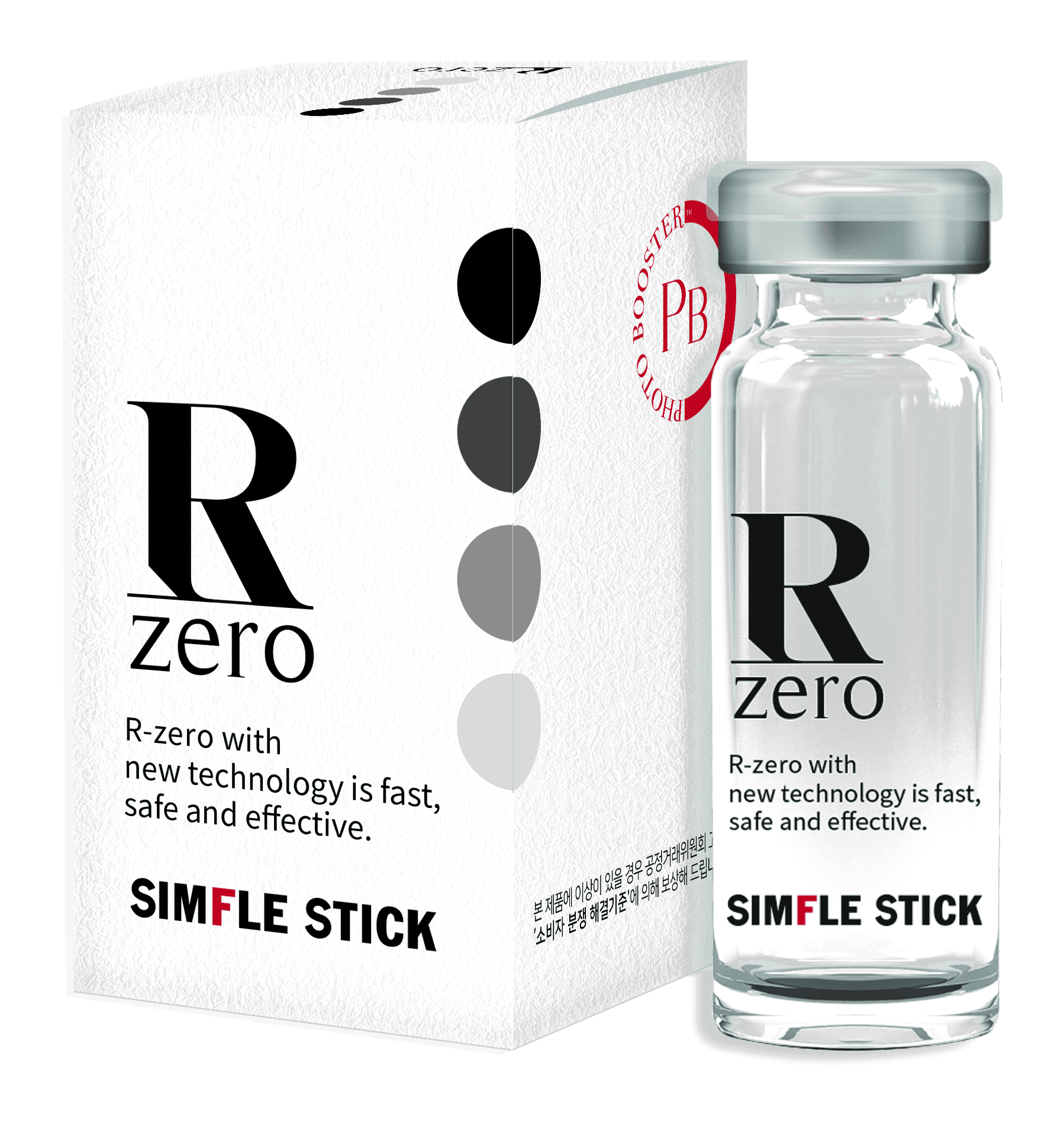
R-zero
Clears the gas-bubble layer between tattoo-removal passes
- Perfluorocarbon dissolves the white frosting the laser leaves behind
- Used alongside a Q-switched or picosecond Nd:YAG
- Up to four passes in one session (manufacturer protocol)
Request a quote
- Protocol training included
- Supplied by Regenesis
About
When a Q-switched or picosecond laser fragments tattoo pigment, it releases gas that forms a white bubble layer in the skin — an optical barrier that stops the next pass. R-zero is a topical solution of perfluorocarbon and optical clearing agents: the perfluorocarbon dissolves the bubbles within a couple of minutes and the clearing agents reduce scattering in the dermis, so the operator can go again in the same session.
Treatment possibilities
Indications from the manufacturer's documentation. Each links to the treatment page.
How to use
R-zero in the treatment room, step by step.
- 01
Prepare
Anaesthetise the area as usual. Allow at least three to four weeks since the previous laser session on the same tattoo.
- 02
First pass
Fire the laser as normal. A white bubble layer forms where the pigment has been hit.
- 03
Apply R-zero
Apply the solution from a syringe with a cotton pad over the frosted area — about 0.5 mL covers 3 × 4 cm.
- 04
Next pass
When the bubbles have cleared, usually within two minutes, fire the next pass. Repeat up to four passes in one session.
- 05
Protocol 2 (manufacturer)
First pass at 80 % energy, apply R-zero, second pass at 100 %, then a fractional CO₂ or Er:YAG pass to reduce blistering.
- 06
Aftercare
No exfoliants or bleaching creams for three days; avoid sun; SPF 30+. Discard any opened solution.
Without R-zeroWith R-zero
Detailed information
Technology, indications and specifications as documented by Simfle Stick Co., Ltd.
- Two agents
- Perfluorocarbon (methyl perfluoroisobutyl ether) dissolves the gas that forms the bubble layer. Glycerin and sorbitol, high-refractive-index clearing agents, reduce scattering so more of the beam reaches the pigment in the upper dermis.
- Why it matters
- Conventional tattoo removal is limited to one pass per session because the frosting blocks the beam. Clearing it lets the operator work the same area several times in one visit, within the limits of the manufacturer's protocol.
- Lasers
- Q-switched and picosecond Nd:YAG. Laser settings are chosen by the laser operator; the manufacturer provides none.
- Ingredients (as stated)
- Perfluorocarbon (methyl perfluoroisobutyl ether) · glycerin · sorbitol
- Used alongside
- Q-switched or picosecond Nd:YAG
- Dose
- 0.5 mL per 3 × 4 cm
- Passes
- Up to 4 per session; bubbles clear within about 2 minutes
- Interval
- At least 3–4 weeks since the previous laser session
- Vial
- 15 mL; discard once opened
- Manufacturer
- Simfle Stick Co., Ltd, Daegu, South Korea
Cautions
- Active infection; keloid or hypertrophic scarring tendency
- Eczema, psoriasis or dermatitis in the area
- Photosensitising medication; recent sun or tanning
- Discard if the solution is opaque, or the vial is damaged or has been opened
Publications
The published study below used a different perfluorodecalin product and supports the multi-pass principle rather than R-zero itself. No study of R-zero has been published.
- Therapeutic effect of the R0 method on tattoo removal in Republic of Korea: retrospective clinical study — Medical Lasers, 2023doi:10.25289/ML.23.014
Talk to us